
 Language
 TIP: Quickly fix some problems with Mac
You feel that your Mac is not working properly? Do you think it might need repair service? Don't worry, many problems with your Mac can be solved with an easy step called NVRAM reset (also known as zapping NVRAM).
What is NVRAM
NVRAM (nonvolatile random-access memory) memory Mac stores certain settings and needs to access them quickly. If this is not working properly, you might feel that your Mac is slow or unrensponsive.
Settings that can be stored in NVRAM:
- sound volume
- display resolution
- startup-disk selection
- time zone
- recent kernel panic information
- and also some other settings from macOS (OS X) system and Mac apps.
Why reset NVRAM on Mac
If you experience issues related to these settings, resetting NVRAM might help. For example, if your Mac starts up from a disk other than the one selected in the Startup Disk preferences, or a question mark icon briefly appears before your Mac starts up, you might need to reset NVRAM.
Resetting the NVRAM will put Mac system’s settings stored in NVRAM back to factory defaults and usually solve most issues.
How to reset NVRAM
The process of NVRAM reset is the same for MacBook, MacBook Pro, MacBook Air, iMac, Mac Pro and Mac Mini.
- Shut down the Mac.
- Press the power button, and as soon as you hear the startup chime, hold down Command+Option+P+R at same time.
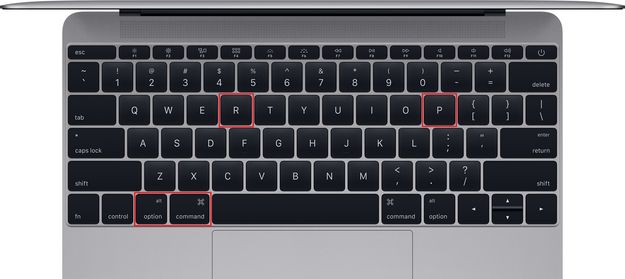
- Keep holding down those keys until you hear a second startup chime sound (about 20s). Then let go and allow your Mac to continue starting normally.
- When your Mac boot up, re-configure any volume settings, screen resolution settings, time zone settings, and start-up disk settings as needed.